Before you brief your agency for another batch of ads, go and look at your Instagram mentions. Seriously. There is a good chance your customers and creators are already making content for you.
Someone posted an unboxing. Someone showed how they use your product. A creator tagged your brand in a Reel that got far more engagement than expected. Until now, most brands would look at that content, like it, maybe repost it, and move on.
Meta is now making it easier to find this kind of creator content and turn eligible posts into Partnership Ads, with the creator's permission. And I think this is a bigger deal for brands than it might initially sound. Because your next winning ad might not need to start with a brief. It might already be sitting in your mentions.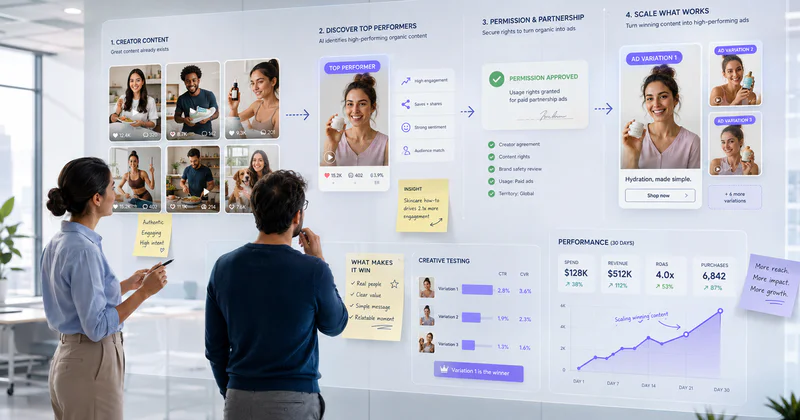
What are Meta Partnership Ads?
Meta Partnership Ads let brands put paid media behind eligible creator content while keeping the creator attached to the ad. The format has become an important part of creator-led advertising on Meta because it combines the familiarity of creator content with the reach and targeting of paid media.
Meta is now expanding how brands can discover this content.
Its latest updates include creator content where people tag or mention a brand, along with other UGC that may be relevant to advertisers. Meta is also adding tools to help brands find and evaluate this content.
That changes the way I would look at organic social content. It is no longer just content for your Instagram feed. It can also become a source of paid creative.
Can brands just use any tagged post as an ad?
No. The creator still needs to give the required permission.
This is important. If someone tags your brand in a Reel, that does not automatically give you advertising rights to their content.
Meta is making the process of requesting and managing permissions easier, but brands still need the appropriate authorization before using creator content as a Partnership Ad.
So the process is more like:
Someone creates content → they tag your brand → you discover the content → you request permission → they approve → you can amplify it.
That is very different from downloading someone's Reel and putting ad spend behind it. And brands should continue to treat creator rights and usage terms seriously.
Why this matters for brands
Because brands now have a much bigger pool of creative to test.
Let's say you launch a new skincare product. Your marketing team commissions five creator videos. At the same time, 30 other people might post about the product organically.
Maybe one creator explains the product better than the five people you hired. Maybe a customer makes a simple video that gets thousands of views. Maybe someone finds a completely different way to demonstrate the product.
That content is valuable. Not because it is necessarily polished. Because it is already being created in the language people are used to seeing on their feeds. And sometimes, that makes it a better starting point for an ad.
Your audience is already telling you what works
This is probably the part I find most interesting.
Organic content can act as a creative testing ground. People are already showing brands which stories they respond to.
They comment on certain product benefits. They share certain videos. They save certain tutorials. They respond to certain hooks. They ignore others.
We spend a lot of money trying to predict what people will like. Meanwhile, our audience is constantly giving us feedback. We just do not always use it.
Meta is making that feedback more useful by giving advertisers more ways to discover creator content and view performance signals around it.
So instead of asking only:
What ad should we make next?
Brands can start asking:
What is already working that we should put more money behind?
That is a much better question.
The best UGC does not always look like an ad
And this is exactly why creator content can be interesting for paid media.
A traditional ad starts with the brand. A creator video often starts with a person. There is a difference.
A customer saying, "I have been using this for two weeks and here's what I noticed" feels very different from a brand saying, "Our product has these five benefits."
The information may be similar. The delivery is not. That is why UGC has become such an important part of social advertising. People do not necessarily want more ads. They want content that gives them a reason to keep watching.
But more UGC creates a new problem
Once brands have more creative options, they also need to produce more variations.
This is where things get interesting for AI.
Imagine you find one creator video that performs really well. Naturally, you want to test it. Maybe you want a shorter version. A different hook. A different opening. A new product visual. A version for another audience. A different format. Five more variations.
Suddenly, one successful piece of content has created a new production requirement. And this is where AI can actually be useful.
AI should help you scale what works
The best use of AI in advertising is not generating random content at scale.
It is helping brands explore and produce more versions of ideas that already have potential.
If a creator has found a great product story, there is no reason to throw that insight away. You can use AI to explore different creative executions around it. Different visual worlds. Different product shots. Different openings. Different formats. Different ways of communicating the same core benefit.
The original creator content remains the signal.
AI helps with the production side. That distinction is important. We do not need another 100 pieces of content just because AI can make them. We need more of the right content.
This is where I see the opportunity for brands
At Gaana AI, we spend a lot of time thinking about this exact problem.
Brands need more creative. But they do not necessarily need more production headaches. They need to be able to take a good idea and explore it properly.
That could mean taking a product image and turning it into a premium product video. It could mean creating multiple visual directions for the same campaign. It could mean adapting a winning creative into different formats. Or it could mean taking an idea that came from a creator and building more content around it.
AI becomes useful when it removes the production bottleneck without removing the creative thinking. That is the sweet spot.
What brands should do now
Start by looking at the content you already have.
Go through your Instagram mentions. Look at tagged posts. Look at creator Reels. Look at customer videos. Look at UGC. Look beyond the content your marketing team commissioned.
Then shortlist the pieces that genuinely have something.
Maybe the hook is good. Maybe the product demonstration is strong. Maybe the creator explains the product beautifully. Maybe the comments are telling you that people actually care.
Those are the pieces worth investigating. From there, check whether the content is eligible for Partnership Ads and get the required creator permission. Then test it.
Do not assume the most polished video will win.
Let the audience tell you.
The bigger shift is already happening
I think we are moving away from the idea that every ad needs to be created from a blank page.
There is simply too much content being created for that to make sense.
Your customers are creating. Your creators are creating. Your community is creating.
Meta is making it easier to discover and activate some of that content through Partnership Ads. AI is making it easier to create variations and produce more premium creative around ideas that work.
Put those things together and you get a very different creative workflow.
Find what people already respond to. Get permission. Amplify it. Create more around it. Test again.
That is a much smarter way to think about creative production than constantly starting from zero. So before you spend your next budget producing ten new ads, take a look at your mentions.
Your next winning ad might already be there.