# About
Name: GaanaAI
Description: GaanaAI produces AI product videos for e-commerce brands -Amazon A+ and listing video, Shopify product pages, TikTok Shop and Instagram Reels. Briefed today, live tomorrow.
URL: https://blog.humanreel.ai
# Navigation Menu
- Home: https://gaanaai.superblog.click/
- Sample Page: https://gaanaai.superblog.click/sample-page
- Search: https://gaanaai.superblog.click/search
- GaanaAI: https://getgaana.com
# Blog Posts
## AI Video Production for Ecommerce Brands:How to Scale Product Video Without Shoot
Author: Marketing Gaana AI
Author URL: https://blog.humanreel.ai/author/marketing-gaana-ai
Published: 2026-09-02
Meta Title: AI Video Production for Ecommerce Brands | GaanaAI
Meta Description: See how growing ecommerce brands can turn existing product photos into high-quality videos for Shopify, Amazon, TikTok, Instagram and paid ads.
Tags: AI Video Production, Ecommerce, Ecommerce Marketing, Amazon Product Video, Shopify Product Video
Tag URLs: AI Video Production (https://blog.humanreel.ai/tag/ai-video-production), Ecommerce (https://blog.humanreel.ai/tag/ecommerce), Ecommerce Marketing (https://blog.humanreel.ai/tag/ecommerce-marketing), Amazon Product Video (https://blog.humanreel.ai/tag/amazon-product-video), Shopify Product Video (https://blog.humanreel.ai/tag/shopify-product-video)
URL: https://blog.humanreel.ai/ai-video-production-for-ecommerce-brands
For most growing ecommerce brands, the problem is no longer whether [video](https://blog.getgaana.com/how-glam-21-marked-ten-years-with-a-campaign-video-on-time) matters. The real problem is producing enough of it without turning every new campaign, SKU, marketplace listing or ad variation into another expensive production cycle.
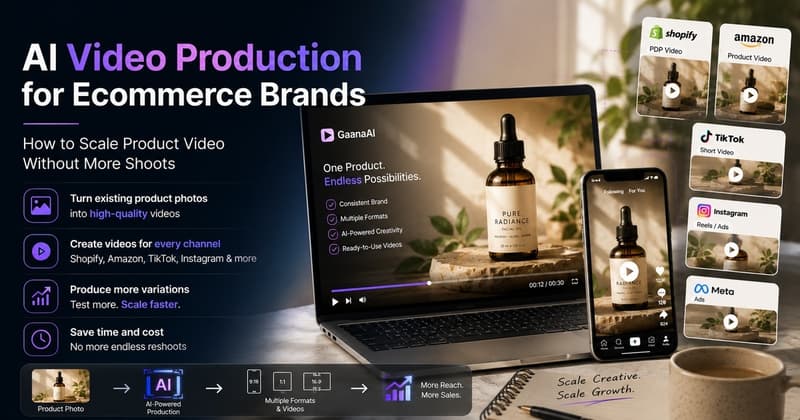
A brand may already have products that sell, strong photography, active paid media, a Shopify store, Amazon listings and a marketing team that knows what needs to be communicated. What usually starts to break is production capacity, because the demand for video grows much faster than the traditional production process can comfortably support.
One product may need a Shopify PDP video, a separate Amazon product video, several TikTok concepts, an Instagram Reel, multiple Meta ad variations and another set of creative for an upcoming promotion. Multiply that across 20, 50 or 200 SKUs and it stops being a simple content problem.
That is where AI video production for ecommerce becomes useful. The value is not in generating one flashy piece of content quickly, but in building a production system that can support the amount of video a growing brand actually needs.
## Why video becomes a production problem as brands grow
Consider a US ecommerce company doing several million dollars in annual revenue. The business has already done the hard work of building a product people buy, creating a recognizable brand and establishing distribution across ecommerce and social channels.
Now the requests start coming from everywhere. Growth wants fresh Meta and TikTok ads, ecommerce wants stronger PDP content, Amazon needs richer listing assets, social needs a steady stream of short-form creative, and the launch calendar keeps adding new products and seasonal campaigns.
None of those requests are unreasonable on their own, but together they create a production workload that is difficult to manage with a traditional shoot-first model.
Traditional product video production still has an important role. A major campaign, hero film, celebrity collaboration or complex product demonstration can absolutely justify a physical production, but it becomes harder to justify that same process for every listing video, ad variation and secondary SKU.
The more useful question for a growing brand is no longer, “How do we make one great video?” It becomes, “How do we continuously produce enough high-quality video without compromising brand standards?”
## Your existing product photography can do more work
Most established ecommerce brands are already sitting on a valuable asset library that includes clean packshots, lifestyle photography, campaign images, PDP photos and marketplace creative. Traditionally, those assets were treated as finished outputs, but they can now become the starting point for another production workflow.
A strong product image to video process can begin with an approved product photo and turn that asset into multiple video concepts without requiring a completely new shoot every time.
Instead of moving through a process like product shipping, production setup, filming, editing and resizing, the workflow can begin with an approved product asset and move directly into creative development and channel-specific video production.
This matters even more for brands with large catalogs or a constant demand for new paid-social creative. In many cases, the brand does not need to ship another physical product sample just to begin producing a new video, because the existing image already gives the production team a strong starting point.
## Product accuracy is where ecommerce AI video gets serious
For ecommerce brands, product fidelity is not a minor technical detail. It is one of the biggest differences between general AI video generation and production-ready AI product video production.
If the packaging changes halfway through a video, the logo shifts, the label becomes distorted, the product proportions drift or a cap suddenly looks different, the final asset may still appear visually impressive while being completely unusable for the brand.
Ecommerce creative has to represent the product a customer will actually receive. That means product shape, packaging, branding, typography and important visual details need to remain stable throughout the entire video.
A video that is 90% accurate can still be 0% usable in ecommerce. The product is not a background prop that AI can freely reinterpret; it is the thing being sold.
That is why brands evaluating an AI video production company should look beyond a polished showreel. The more important question is whether the production workflow can create strong visuals while keeping the actual product accurate from beginning to end.
## One product should support more than one channel
The real value of AI production becomes clearer when one approved product asset can support several different marketing jobs. A brand should not assume that one universal video can simply be posted everywhere, because each channel has a different audience, format and buying context.
### Shopify product video
A Shopify PDP usually needs video that helps a customer understand the product more clearly rather than a highly produced advertisement.
A good Shopify product video might show the product in context, demonstrate how it is used, highlight an important feature or make the product feel more tangible than static photography alone.
Producing that type of video across dozens of SKUs through traditional shoots can still become expensive and slow, which is why AI-assisted production becomes especially useful at catalog scale.
For brands exploring more scalable PDP content, a dedicated AI product video production workflow can help existing product imagery work harder across the store.
### Amazon product video
An Amazon product video has a different job because the shopper is already closer to purchase.
The creative can focus more heavily on the product itself, its key benefits, use cases, demonstrations or visual details that help someone make a buying decision.
For brands managing a large Amazon catalog, the challenge is often not deciding whether video would help. It is finding a practical way to produce enough of it across multiple listings without treating every SKU like a separate production project.
A dedicated Amazon product video workflow can help brands expand video coverage across more of their catalog without rebuilding production from scratch each time.
### TikTok and TikTok Shop
TikTok is much more dependent on creative testing, especially for brands running paid campaigns or selling through TikTok Shop.
A single product may need several hooks, different openings, lifestyle concepts and new visual angles before the team finds the version that performs best.
That makes TikTok product video a strong use case for AI production because the goal is not to create one perfect asset and stop. The goal is to produce enough strong variations to give the media team something meaningful to test.
### Instagram and Meta
Instagram Reels and Meta ads create a similar need for variation. The same product may need a lifestyle concept, a feature-led video, a problem-solution angle, a seasonal version or a completely different opening for a new audience.
The product remains consistent, but the creative around it changes. This is where AI video ads for ecommerce become especially useful because brands can explore more concepts without rebuilding the entire production process for every new idea.
## The biggest advantage is not simply cheaper video
Lower production cost is useful, but it is not the most interesting part of the shift.
The bigger opportunity is that brands can start producing videos they previously would not have produced at all.
A lower-volume SKU that would never justify its own traditional shoot can now have a PDP or marketplace video. A growth team that could only afford one ad opening can test several. A brand with excellent Amazon photography but limited video coverage can expand video across more listings.
This is what product videos at scale should mean in practice. It is not about generating one video quickly; it is about increasing production capacity enough that video can be used across more products, more campaigns and more stages of the customer journey.
For established ecommerce companies, that can be far more valuable than simply making one existing production cheaper.
## What scalable ecommerce video production actually looks like
Imagine a brand with 50 products.
A traditional approach might treat those as 50 separate video projects. A more scalable approach starts by identifying repeatable creative formats and applying them across the catalog while keeping each product and channel-specific output distinct.
One product may need a Shopify PDP video, an Amazon listing video, a TikTok lifestyle concept, an Instagram Reel and a Meta ad variation. Another may only need a feature demonstration, an Amazon video and a paid-social concept.
A newly launched SKU may need a product launch video, TikTok Shop creative, paid-media variations and several PDP assets at once.
The objective is not to make every piece of creative identical. The objective is to make the product video production process repeatable enough that every new SKU does not force the team to start from zero.
Once that system exists, the brand can spend more time deciding which creative ideas are worth producing and less time coordinating production itself.
## AI video generator and AI video production are not the same thing
This distinction matters because the buyer is different.
An AI video generator gives someone software. An AI video production company should give the brand finished creative that is actually ready to use.
Most established ecommerce teams do not necessarily want another dashboard they have to learn, prompt, troubleshoot and quality-check throughout the day. They already have enough tools in their marketing stack; what they need is more reliable creative output.
A production service should therefore handle the parts that software alone does not solve, including creative judgment, brand consistency, product accuracy, channel awareness, revisions and quality control.
AI may power the workflow, but it should reduce the operational burden on the marketing team rather than handing that team another production job.
## When AI product video production makes the most sense
AI production becomes most valuable once a brand already has something worth scaling.
The strongest use cases are usually companies with proven products, existing revenue, professional product photography, multiple SKUs, active paid media and a regular demand for new creative across stores, marketplaces and social platforms.
A company that is still deciding what its product is, who the customer is or whether there is meaningful demand has a different set of priorities. Producing dozens of videos will not solve product-market fit.
For a brand that already knows what sells, however, the challenge changes completely. The company is no longer trying to build everything from scratch; it is trying to increase output around products and messages that are already working.
That is where AI video becomes much more interesting. It is less about helping a company go from zero to one and more about helping an established brand go from one to ten.
## Traditional shoots still matter
AI production should not be treated as a replacement for every type of shoot.
Major brand campaigns, hero films, celebrity partnerships, complex demonstrations and highly specific real-world interactions may still benefit from traditional production.
The smarter approach is to decide which assets genuinely require physical production and which do not.
A hero campaign may deserve a full crew, location and traditional production setup, while the next 50 PDP videos, marketplace assets or ad variations may not need the same level of production overhead.
That hybrid model allows brands to use traditional production where it creates the most value while using AI to remove unnecessary friction from high-volume creative needs.
## What should brands look for in an AI video production partner?
The first thing to evaluate is product accuracy. Look carefully at whether the product shape, logo, packaging, typography, color, proportions and important details remain consistent throughout the final video.
The second question is whether the production team can work effectively from assets you already own. A good workflow should help you get more value from your existing product photography instead of requiring another physical shoot whenever you need fresh creative.
Channel awareness matters too. A Shopify PDP video, Amazon listing video and TikTok ad are not interchangeable assets, and a useful production partner should understand why those formats require different creative approaches.
Finally, ask how the team handles variation and quality control. Scaling video means being able to create new hooks, concepts, aspect ratios and scenes without restarting every project from scratch, but speed only matters if someone is still checking whether the final asset is genuinely usable.
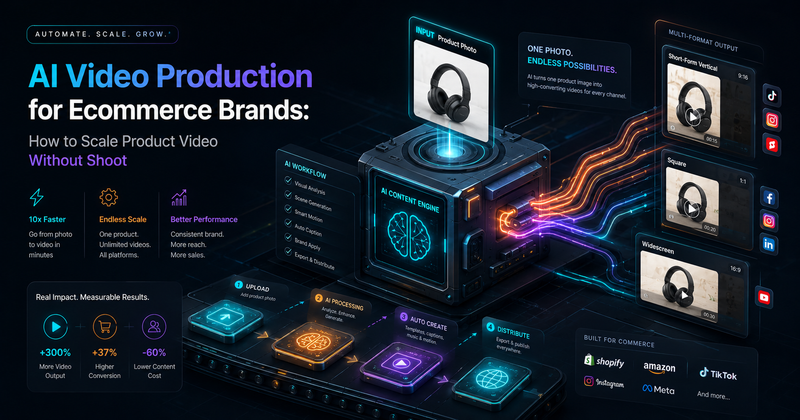
## One product photo can become the start of a much larger video pipeline
A product photograph no longer has to be treated as the end of the creative process. For growing ecommerce brands, it can become the beginning of a larger production system that creates content for Shopify, Amazon, TikTok Shop, Instagram, Meta ads, PDPs, marketplaces and product launches.
That does not remove the need for creative strategy, strong branding or human judgment. It simply gives those teams more production capacity to execute good ideas without relying on another physical shoot every time they need a new asset.
For established ecommerce brands, that is the real promise of AI video production for ecommerce. The opportunity is not simply to generate video faster, but to build a production system that can keep pace with the business itself.
When the products, customers and demand are already there, additional creative capacity can become a real growth advantage.
## Frequently Asked Questions
### What is AI product video production?
AI product video production uses AI-assisted workflows to turn existing product assets, such as professional product photography, into finished marketing videos. For established brands, a production-ready process should also include creative direction, product fidelity, quality control, revisions and delivery for specific channels.
### Can you create a product video from one photo?
Yes. A product photo to video workflow can use a single approved product image as the starting point for video production. The quality of the source image and the production workflow both have a significant impact on the final result.
### Do brands need to ship the physical product?
Not for every AI video use case. Many concepts can begin with approved product photography, which can reduce the need to ship physical samples purely for video production.
### Can AI be used for Amazon and Shopify product videos?
Yes. AI-assisted production can be used to create product-focused assets for Amazon listings and Shopify PDPs, as long as the final content accurately represents the product and is produced for the requirements of the specific channel.
### Is AI video production useful for TikTok and Instagram?
Yes. TikTok, Instagram and Meta are particularly strong use cases because marketing teams often need multiple hooks, creative concepts and variations around the same product.
### What is the difference between an AI video generator and an AI video production company?
An AI video generator primarily provides the technology to create video. An AI video production company manages the broader process, including creative direction, product consistency, revisions, quality control and delivery of finished marketing assets.
### Which brands benefit most from AI video production?
The strongest fit is usually an established or growing ecommerce brand that already has proven products, professional product assets and active marketing channels but needs more video than its existing production process can efficiently deliver.
**Recommended internal links**
- AI Product Video Production → /ai-product-video-production/
- Product Image to Video → /product-image-to-video/
- Amazon Product Video → /amazon-product-video/
- Shopify Product Video → /shopify-product-video/
- TikTok Product Video → /tiktok-product-video/
- AI Video Ads → /ai-video-ads/
## Already have the product photo?
Turn your existing product assets into high-quality videos for your store, marketplaces and campaigns without organizing another traditional shoot every time your team needs new creative.
[https://www.getgaana.com/](https://www.getgaana.com/)
## FAQs
Q: How does AI video production help ecommerce brands scale content?
A: AI video production helps ecommerce brands create more video from product assets they already have. Instead of organizing a new shoot for every SKU, campaign or creative variation, brands can use existing product photography as the starting point for videos across stores, marketplaces, paid ads and social channels.
Q: Can AI turn product images into marketing videos?
A: Yes. Product image to video workflows can transform approved product photography into marketing videos by adding motion, environments, product interactions and other creative elements. For ecommerce use, the production process should prioritize keeping the actual product, packaging, branding and important visual details accurate.
Q: Can one product photo be used to create multiple videos?
A: Yes. One strong product photo can become the starting point for multiple video concepts, including product-focused videos, lifestyle creative, feature-led content, paid-social variations and marketplace assets. The same product can be presented differently depending on the channel and campaign objective.
Q: Can AI product videos maintain accurate packaging and branding?
A: Product accuracy should be a core part of a production-ready AI video workflow. Product shape, logo, packaging, typography, colors and other important details need to remain consistent throughout the final video for the content to be usable by an ecommerce brand.
Q: Can AI video production reduce the need for product shoots?
A: For many ecommerce video requirements, yes. Existing product photography can often provide enough visual information to begin production without organizing another physical shoot. Traditional shoots may still make sense for major campaigns, complex demonstrations, celebrity collaborations or highly specific real-world interactions.
---
This blog is powered by Superblog. Visit https://superblog.ai to know more.
---
## Meta Partnership Ads: Your Next Winning Ad Might Already Exist
Author: Marketing Gaana AI
Author URL: https://blog.humanreel.ai/author/marketing-gaana-ai
Published: 2026-08-28
Category: Blogs
Category URL: https://blog.humanreel.ai/category/blogs
Meta Title: Meta Partnership Ads: Your Next Winning Ad Already Exists
Meta Description: Meta helps brands turn eligible creator posts into Partnership Ads with creator permission.
Tags: AI video, AI video ads, Meta Partnership Ads, AI Advertising, Instagram Partnership Ads
Tag URLs: AI video (https://blog.humanreel.ai/tag/ai-video), AI video ads (https://blog.humanreel.ai/tag/ai-video-ads), Meta Partnership Ads (https://blog.humanreel.ai/tag/meta-partnership-ads), AI Advertising (https://blog.humanreel.ai/tag/ai-advertising), Instagram Partnership Ads (https://blog.humanreel.ai/tag/instagram-partnership-ads)
URL: https://blog.humanreel.ai/meta-partnership-ad-your-next-winning-ad-might-already-exist
Before you brief your agency for another batch of ads, go and look at your Instagram mentions. Seriously. There is a good chance your customers and creators are [already making content](https://blog.getgaana.com/how-glam-21-marked-ten-years-with-a-campaign-video-on-time) for you.
Someone posted an unboxing. Someone showed how they use your product. A creator tagged your brand in a Reel that got far more engagement than expected. Until now, most brands would look at that content, like it, maybe repost it, and move on.
Meta is now making it easier to find this kind of creator content and turn eligible posts into Partnership Ads, with the creator's permission. And I think this is a bigger deal for brands than it might initially sound. Because your next winning ad might not need to start with a brief. It might already be sitting in your mentions.

## What are Meta Partnership Ads?
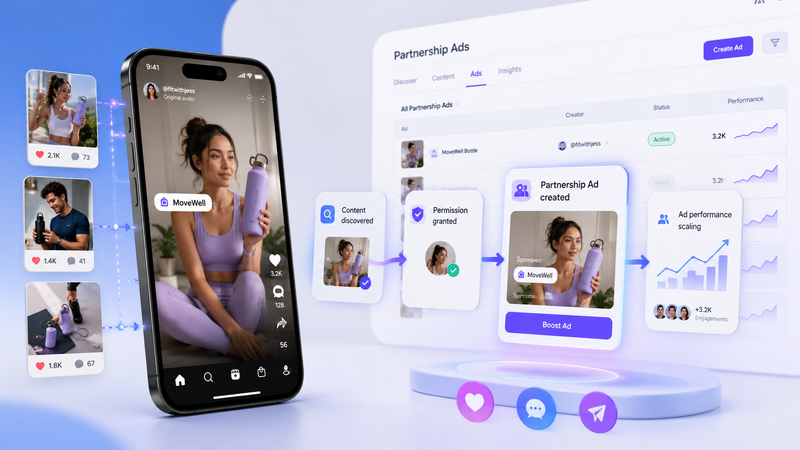
Meta Partnership Ads let brands put paid media behind eligible creator content while keeping the creator attached to the ad. The format has become an important part of creator-led advertising on Meta because it combines the familiarity of creator content with the reach and targeting of paid media.
### Meta is now expanding how brands can discover this content.
Its latest updates include creator content where people tag or mention a brand, along with other UGC that may be relevant to advertisers. Meta is also adding tools to help brands find and evaluate this content.
That changes the way I would look at organic social content. It is no longer just content for your Instagram feed. It can also become a source of paid creative.
## Can brands just use any tagged post as an ad?
### No. The creator still needs to give the required permission.
This is important. If someone tags your brand in a Reel, that does not automatically give you advertising rights to their content.
Meta is making the process of requesting and managing permissions easier, but brands still need the appropriate authorization before using creator content as a Partnership Ad.
### So the process is more like:
**Someone creates content → they tag your brand → you discover the content → you request permission → they approve → you can amplify it.**
That is very different from downloading someone's Reel and putting ad spend behind it. And brands should continue to treat creator rights and usage terms seriously.
## Why this matters for brands
### Because brands now have a much bigger pool of creative to test.
Let's say you launch a new skincare product. Your marketing team commissions five creator videos. At the same time, 30 other people might post about the product organically.
Maybe one creator explains the product better than the five people you hired. Maybe a customer makes a simple video that gets thousands of views. Maybe someone finds a completely different way to demonstrate the product.
That content is valuable. Not because it is necessarily polished. Because it is already being created in the language people are used to seeing on their feeds. And sometimes, that makes it a better starting point for an ad.
## Your audience is already telling you what works
### This is probably the part I find most interesting.
Organic content can act as a creative testing ground. People are already showing brands which stories they respond to.
They comment on certain product benefits. They share certain videos. They save certain tutorials. They respond to certain hooks. They ignore others.
We spend a lot of money trying to predict what people will like. Meanwhile, our audience is constantly giving us feedback. We just do not always use it.
Meta is making that feedback more useful by giving advertisers more ways to discover creator content and view performance signals around it.
### So instead of asking only:
**What ad should we make next?**
### Brands can start asking:
**What is already working that we should put more money behind?**
That is a much better question.
## The best UGC does not always look like an ad
### And this is exactly why creator content can be interesting for paid media.
A traditional ad starts with the brand. A creator video often starts with a person. There is a difference.
A customer saying, "I have been using this for two weeks and here's what I noticed" feels very different from a brand saying, "Our product has these five benefits."
The information may be similar. The delivery is not. That is why UGC has become such an important part of social advertising. People do not necessarily want more ads. They want content that gives them a reason to keep watching.
## But more UGC creates a new problem
### Once brands have more creative options, they also need to produce more variations.
This is where things get interesting for AI.
Imagine you find one creator video that performs really well. Naturally, you want to test it. Maybe you want a shorter version. A different hook. A different opening. A new product visual. A version for another audience. A different format. Five more variations.
Suddenly, one successful piece of content has created a new production requirement. And this is where AI can actually be useful.
## AI should help you scale what works
### The best use of AI in advertising is not generating random content at scale.
It is helping brands explore and produce more versions of ideas that already have potential.
If a creator has found a great product story, there is no reason to throw that insight away. You can use AI to explore different creative executions around it. Different visual worlds. Different product shots. Different openings. Different formats. Different ways of communicating the same core benefit.
### The original creator content remains the signal.
AI helps with the production side. That distinction is important. We do not need another 100 pieces of content just because AI can make them. We need more of the right content.
## This is where I see the opportunity for brands
### At Gaana AI, we spend a lot of time thinking about this exact problem.
Brands need more creative. But they do not necessarily need more production headaches. They need to be able to take a good idea and explore it properly.
That could mean taking a product image and turning it into a premium product video. It could mean creating multiple visual directions for the same campaign. It could mean adapting a winning creative into different formats. Or it could mean taking an idea that came from a creator and building more content around it.
AI becomes useful when it removes the production bottleneck without removing the creative thinking. That is the sweet spot.
## What brands should do now
### Start by looking at the content you already have.
Go through your Instagram mentions. Look at tagged posts. Look at creator Reels. Look at customer videos. Look at UGC. Look beyond the content your marketing team commissioned.
### Then shortlist the pieces that genuinely have something.
Maybe the hook is good. Maybe the product demonstration is strong. Maybe the creator explains the product beautifully. Maybe the comments are telling you that people actually care.
Those are the pieces worth investigating. From there, check whether the content is eligible for Partnership Ads and get the required creator permission. Then test it.
### Do not assume the most polished video will win.
Let the audience tell you.
## The bigger shift is already happening
### I think we are moving away from the idea that every ad needs to be created from a blank page.
There is simply too much content being created for that to make sense.
Your customers are creating. Your creators are creating. Your community is creating.
Meta is making it easier to discover and activate some of that content through Partnership Ads. AI is making it easier to create variations and produce more premium creative around ideas that work.
### Put those things together and you get a very different creative workflow.
Find what people already respond to. Get permission. Amplify it. Create more around it. Test again.
That is a much smarter way to think about creative production than constantly starting from zero. So before you spend your next budget producing ten new ads, take a look at your mentions.
**Your next winning ad might already be there.**
---
This blog is powered by Superblog. Visit https://superblog.ai to know more.
---
## How Glam 21 Marked Ten Years With A Campaign Video, On Time
Author: Marketing Gaana AI
Author URL: https://blog.humanreel.ai/author/marketing-gaana-ai
Published: 2026-08-20
Category: Case Studies
Category URL: https://blog.humanreel.ai/category/case-studies
Tags: AI video, Instagram reel, Beauty marketing, AI video ads, beauty ecommerce
Tag URLs: AI video (https://blog.humanreel.ai/tag/ai-video), Instagram reel (https://blog.humanreel.ai/tag/instagram-reel), Beauty marketing (https://blog.humanreel.ai/tag/beauty-marketing), AI video ads (https://blog.humanreel.ai/tag/ai-video-ads), beauty ecommerce (https://blog.humanreel.ai/tag/beauty-ecommerce)
URL: https://blog.humanreel.ai/how-glam-21-marked-ten-years-with-a-campaign-video-on-time
Glam 21 started in 2016 and has grown into a beauty brand worth more than $12 million, sold in over 25,000 stores across India.
It competes for the same Gen Z shopper as Swiss Beauty, MARS, Sugar and Renee, in a category where price and trend cycle matter as much as formula.
This August, Glam 21 turned ten years old and launched a “10 and Trending” anniversary sale to mark it, with an explicit target of roughly $60 million in revenue in the next two to three years.
Ten years is a real number in a category where most D2C beauty brands do not survive five.
It deserved a campaign that actually landed on the anniversary date, not one that trickled out after the moment had already passed.
## The problem
A milestone campaign only works if the video exists when the campaign launches.
A normal production shoot takes weeks of planning, casting, scheduling, and editing, timelines that most brand anniversary dates simply do not allow for once the date is locked.
This is a familiar bind for fast moving consumer brands generally.
Marketing calendars are set months in advance.
Production pipelines are not built to move at the same speed.
The gap between when a campaign needs to launch and when a traditional shoot can realistically deliver is where a lot of good marketing ideas quietly die before they ever go live.
## Before and after
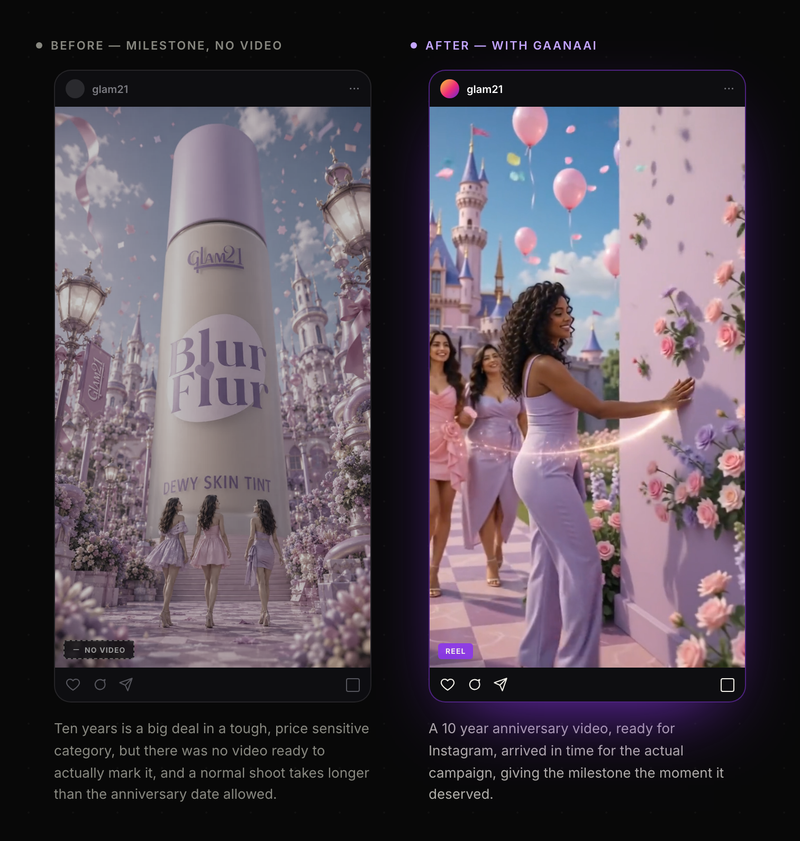
## What we did
We worked backward from Glam 21's real anniversary date, not around a production calendar.
01
### **Campaign brief**
- We reviewed Glam 21's brand identity, the “10 and Trending” campaign direction, and its Gen Z focused audience.
- We aligned the video concept to the milestone itself, ten years of the brand, rather than a generic product push.
02
### **AI production**
- We built an anniversary campaign video from Glam 21's existing brand assets, formatted specifically for Instagram.
- The video was reviewed against brand guidelines to keep it consistent with Glam 21's existing visual identity.
03
### **Publish for launch day**
- The finished video was delivered ready to publish in time for the actual anniversary campaign window.
- No production delay stood between the milestone date and the content meant to mark it.
> A ten year milestone deserved a video that looked considered, not rushed out by a machine. **The anniversary date fixed the deadline, and AI is what made it reachable, but the milestone demanded polish.** Ten years of brand equity would be cheapened by anything that looked auto generated, so the AI worked under the same creative standards as a traditional campaign.
## The result
The anniversary video [went live on Instagram](https://www.instagram.com/reels/DV1BcLsgfnn/) in time for the real “10 and Trending” campaign, giving a ten year milestone the moment it deserved in front of the younger audience Glam 21 is actively courting as it targets its next stage of growth.
What we did, in one line
We made a campaign video for Glam 21 to celebrate their 10 year milestone and build brand pride and engagement. Made with AI, built for Instagram, delivered ready to publish.
> A milestone campaign that launches after the milestone has passed is not a campaign, it is an apology.
## Why this matters
Beauty is one of the fastest moving categories in D2C marketing, and its content needs move at the same speed as its trend cycles.
A brand's marketing calendar rarely bends for a production pipeline, which means the pipeline is usually what has to change.
Anniversary campaigns are only one example.
Product launches, festive pushes, influencer tie ins, all of it depends on video existing on the date it is needed, not sometime near it.
Brands that can close that gap keep more of their planned campaigns intact instead of watching good ideas slip past their own launch dates.
A ten year anniversary campaign is exactly the kind of moment where AI slop would have done real damage to the brand.
Glam 21 needed the speed AI makes possible, since the anniversary date was fixed, but the video also had to hold up next to a decade of brand marketing.
That only happens when AI production is paired with real creative direction, not treated as a replacement for it.
Premium output is what earns engagement, not just the fact that a video exists.
AI video ads let beauty brands hit campaign dates that cannot slip, the same constraint [Epson faced with its holiday retail calendar](https://getgaana.com/case-studies/epson-holiday-campaign/), where the dates were set by the season rather than the brand.
#AI video Instagram reelBeauty marketing
---
This blog is powered by Superblog. Visit https://superblog.ai to know more.
---
## Sample Page
Author: Marketing Gaana AI
Author URL: https://blog.humanreel.ai/author/marketing-gaana-ai
Published: 2026-08-18
URL: https://blog.humanreel.ai/sample-page
This is a page. Notice how there are no elements like author, date, social sharing icons?
Yes, this is the page format. You can create a whole website using Superblog if you wish to do so!
---
This blog is powered by Superblog. Visit https://superblog.ai to know more.
---