For most growing ecommerce brands, the problem is no longer whether video matters. The real problem is producing enough of it without turning every new campaign, SKU, marketplace listing or ad variation into another expensive production cycle.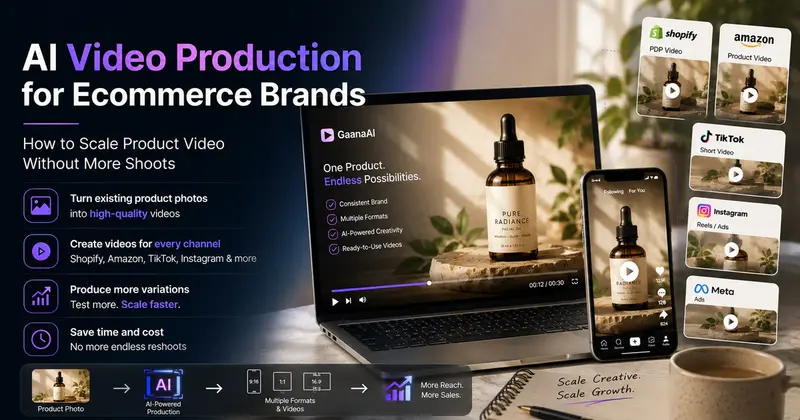
A brand may already have products that sell, strong photography, active paid media, a Shopify store, Amazon listings and a marketing team that knows what needs to be communicated. What usually starts to break is production capacity, because the demand for video grows much faster than the traditional production process can comfortably support.
One product may need a Shopify PDP video, a separate Amazon product video, several TikTok concepts, an Instagram Reel, multiple Meta ad variations and another set of creative for an upcoming promotion. Multiply that across 20, 50 or 200 SKUs and it stops being a simple content problem.
That is where AI video production for ecommerce becomes useful. The value is not in generating one flashy piece of content quickly, but in building a production system that can support the amount of video a growing brand actually needs.
Why video becomes a production problem as brands grow
Consider a US ecommerce company doing several million dollars in annual revenue. The business has already done the hard work of building a product people buy, creating a recognizable brand and establishing distribution across ecommerce and social channels.
Now the requests start coming from everywhere. Growth wants fresh Meta and TikTok ads, ecommerce wants stronger PDP content, Amazon needs richer listing assets, social needs a steady stream of short-form creative, and the launch calendar keeps adding new products and seasonal campaigns.
None of those requests are unreasonable on their own, but together they create a production workload that is difficult to manage with a traditional shoot-first model.
Traditional product video production still has an important role. A major campaign, hero film, celebrity collaboration or complex product demonstration can absolutely justify a physical production, but it becomes harder to justify that same process for every listing video, ad variation and secondary SKU.
The more useful question for a growing brand is no longer, “How do we make one great video?” It becomes, “How do we continuously produce enough high-quality video without compromising brand standards?”
Your existing product photography can do more work
Most established ecommerce brands are already sitting on a valuable asset library that includes clean packshots, lifestyle photography, campaign images, PDP photos and marketplace creative. Traditionally, those assets were treated as finished outputs, but they can now become the starting point for another production workflow.
A strong product image to video process can begin with an approved product photo and turn that asset into multiple video concepts without requiring a completely new shoot every time.
Instead of moving through a process like product shipping, production setup, filming, editing and resizing, the workflow can begin with an approved product asset and move directly into creative development and channel-specific video production.
This matters even more for brands with large catalogs or a constant demand for new paid-social creative. In many cases, the brand does not need to ship another physical product sample just to begin producing a new video, because the existing image already gives the production team a strong starting point.
Product accuracy is where ecommerce AI video gets serious
For ecommerce brands, product fidelity is not a minor technical detail. It is one of the biggest differences between general AI video generation and production-ready AI product video production.
If the packaging changes halfway through a video, the logo shifts, the label becomes distorted, the product proportions drift or a cap suddenly looks different, the final asset may still appear visually impressive while being completely unusable for the brand.
Ecommerce creative has to represent the product a customer will actually receive. That means product shape, packaging, branding, typography and important visual details need to remain stable throughout the entire video.
A video that is 90% accurate can still be 0% usable in ecommerce. The product is not a background prop that AI can freely reinterpret; it is the thing being sold.
That is why brands evaluating an AI video production company should look beyond a polished showreel. The more important question is whether the production workflow can create strong visuals while keeping the actual product accurate from beginning to end.
One product should support more than one channel
The real value of AI production becomes clearer when one approved product asset can support several different marketing jobs. A brand should not assume that one universal video can simply be posted everywhere, because each channel has a different audience, format and buying context.
Shopify product video
A Shopify PDP usually needs video that helps a customer understand the product more clearly rather than a highly produced advertisement.
A good Shopify product video might show the product in context, demonstrate how it is used, highlight an important feature or make the product feel more tangible than static photography alone.
Producing that type of video across dozens of SKUs through traditional shoots can still become expensive and slow, which is why AI-assisted production becomes especially useful at catalog scale.
For brands exploring more scalable PDP content, a dedicated AI product video production workflow can help existing product imagery work harder across the store.
Amazon product video
An Amazon product video has a different job because the shopper is already closer to purchase.
The creative can focus more heavily on the product itself, its key benefits, use cases, demonstrations or visual details that help someone make a buying decision.
For brands managing a large Amazon catalog, the challenge is often not deciding whether video would help. It is finding a practical way to produce enough of it across multiple listings without treating every SKU like a separate production project.
A dedicated Amazon product video workflow can help brands expand video coverage across more of their catalog without rebuilding production from scratch each time.
TikTok and TikTok Shop
TikTok is much more dependent on creative testing, especially for brands running paid campaigns or selling through TikTok Shop.
A single product may need several hooks, different openings, lifestyle concepts and new visual angles before the team finds the version that performs best.
That makes TikTok product video a strong use case for AI production because the goal is not to create one perfect asset and stop. The goal is to produce enough strong variations to give the media team something meaningful to test.
Instagram and Meta
Instagram Reels and Meta ads create a similar need for variation. The same product may need a lifestyle concept, a feature-led video, a problem-solution angle, a seasonal version or a completely different opening for a new audience.
The product remains consistent, but the creative around it changes. This is where AI video ads for ecommerce become especially useful because brands can explore more concepts without rebuilding the entire production process for every new idea.
The biggest advantage is not simply cheaper video
Lower production cost is useful, but it is not the most interesting part of the shift.
The bigger opportunity is that brands can start producing videos they previously would not have produced at all.
A lower-volume SKU that would never justify its own traditional shoot can now have a PDP or marketplace video. A growth team that could only afford one ad opening can test several. A brand with excellent Amazon photography but limited video coverage can expand video across more listings.
This is what product videos at scale should mean in practice. It is not about generating one video quickly; it is about increasing production capacity enough that video can be used across more products, more campaigns and more stages of the customer journey.
For established ecommerce companies, that can be far more valuable than simply making one existing production cheaper.
What scalable ecommerce video production actually looks like
Imagine a brand with 50 products.
A traditional approach might treat those as 50 separate video projects. A more scalable approach starts by identifying repeatable creative formats and applying them across the catalog while keeping each product and channel-specific output distinct.
One product may need a Shopify PDP video, an Amazon listing video, a TikTok lifestyle concept, an Instagram Reel and a Meta ad variation. Another may only need a feature demonstration, an Amazon video and a paid-social concept.
A newly launched SKU may need a product launch video, TikTok Shop creative, paid-media variations and several PDP assets at once.
The objective is not to make every piece of creative identical. The objective is to make the product video production process repeatable enough that every new SKU does not force the team to start from zero.
Once that system exists, the brand can spend more time deciding which creative ideas are worth producing and less time coordinating production itself.
AI video generator and AI video production are not the same thing
This distinction matters because the buyer is different.
An AI video generator gives someone software. An AI video production company should give the brand finished creative that is actually ready to use.
Most established ecommerce teams do not necessarily want another dashboard they have to learn, prompt, troubleshoot and quality-check throughout the day. They already have enough tools in their marketing stack; what they need is more reliable creative output.
A production service should therefore handle the parts that software alone does not solve, including creative judgment, brand consistency, product accuracy, channel awareness, revisions and quality control.
AI may power the workflow, but it should reduce the operational burden on the marketing team rather than handing that team another production job.
When AI product video production makes the most sense
AI production becomes most valuable once a brand already has something worth scaling.
The strongest use cases are usually companies with proven products, existing revenue, professional product photography, multiple SKUs, active paid media and a regular demand for new creative across stores, marketplaces and social platforms.
A company that is still deciding what its product is, who the customer is or whether there is meaningful demand has a different set of priorities. Producing dozens of videos will not solve product-market fit.
For a brand that already knows what sells, however, the challenge changes completely. The company is no longer trying to build everything from scratch; it is trying to increase output around products and messages that are already working.
That is where AI video becomes much more interesting. It is less about helping a company go from zero to one and more about helping an established brand go from one to ten.
Traditional shoots still matter
AI production should not be treated as a replacement for every type of shoot.
Major brand campaigns, hero films, celebrity partnerships, complex demonstrations and highly specific real-world interactions may still benefit from traditional production.
The smarter approach is to decide which assets genuinely require physical production and which do not.
A hero campaign may deserve a full crew, location and traditional production setup, while the next 50 PDP videos, marketplace assets or ad variations may not need the same level of production overhead.
That hybrid model allows brands to use traditional production where it creates the most value while using AI to remove unnecessary friction from high-volume creative needs.
What should brands look for in an AI video production partner?
The first thing to evaluate is product accuracy. Look carefully at whether the product shape, logo, packaging, typography, color, proportions and important details remain consistent throughout the final video.
The second question is whether the production team can work effectively from assets you already own. A good workflow should help you get more value from your existing product photography instead of requiring another physical shoot whenever you need fresh creative.
Channel awareness matters too. A Shopify PDP video, Amazon listing video and TikTok ad are not interchangeable assets, and a useful production partner should understand why those formats require different creative approaches.
Finally, ask how the team handles variation and quality control. Scaling video means being able to create new hooks, concepts, aspect ratios and scenes without restarting every project from scratch, but speed only matters if someone is still checking whether the final asset is genuinely usable.
One product photo can become the start of a much larger video pipeline
A product photograph no longer has to be treated as the end of the creative process. For growing ecommerce brands, it can become the beginning of a larger production system that creates content for Shopify, Amazon, TikTok Shop, Instagram, Meta ads, PDPs, marketplaces and product launches.
That does not remove the need for creative strategy, strong branding or human judgment. It simply gives those teams more production capacity to execute good ideas without relying on another physical shoot every time they need a new asset.
For established ecommerce brands, that is the real promise of AI video production for ecommerce. The opportunity is not simply to generate video faster, but to build a production system that can keep pace with the business itself.
When the products, customers and demand are already there, additional creative capacity can become a real growth advantage.
Frequently Asked Questions
What is AI product video production?
AI product video production uses AI-assisted workflows to turn existing product assets, such as professional product photography, into finished marketing videos. For established brands, a production-ready process should also include creative direction, product fidelity, quality control, revisions and delivery for specific channels.
Can you create a product video from one photo?
Yes. A product photo to video workflow can use a single approved product image as the starting point for video production. The quality of the source image and the production workflow both have a significant impact on the final result.
Do brands need to ship the physical product?
Not for every AI video use case. Many concepts can begin with approved product photography, which can reduce the need to ship physical samples purely for video production.
Can AI be used for Amazon and Shopify product videos?
Yes. AI-assisted production can be used to create product-focused assets for Amazon listings and Shopify PDPs, as long as the final content accurately represents the product and is produced for the requirements of the specific channel.
Is AI video production useful for TikTok and Instagram?
Yes. TikTok, Instagram and Meta are particularly strong use cases because marketing teams often need multiple hooks, creative concepts and variations around the same product.
What is the difference between an AI video generator and an AI video production company?
An AI video generator primarily provides the technology to create video. An AI video production company manages the broader process, including creative direction, product consistency, revisions, quality control and delivery of finished marketing assets.
Which brands benefit most from AI video production?
The strongest fit is usually an established or growing ecommerce brand that already has proven products, professional product assets and active marketing channels but needs more video than its existing production process can efficiently deliver.
Recommended internal links
AI Product Video Production → /ai-product-video-production/
Product Image to Video → /product-image-to-video/
Amazon Product Video → /amazon-product-video/
Shopify Product Video → /shopify-product-video/
TikTok Product Video → /tiktok-product-video/
AI Video Ads → /ai-video-ads/
Already have the product photo?
Turn your existing product assets into high-quality videos for your store, marketplaces and campaigns without organizing another traditional shoot every time your team needs new creative.